
At ArisGlobal, innovation has never been just about the technology itself. It has always been just as much about how we get that technology into our customers’ hands, quickly, cost-effectively, and in a way that lets them stay focused on the work that actually matters: bringing life-saving therapies to patients. RapidPV, our fast-delivery model for LifeSphere MultiVigilance, is one of the clearest expressions of that philosophy, and it is already changing how small and mid-size pharma, biotech, medical device, and CRO organizations think about their safety infrastructure.
The Squeeze Every Emerging Innovator Feels
Ask almost any small or emerging biotech what keeps their leadership team up at night, and the answer rarely starts with technology. It starts with the science: does the molecule work, is it safe, will the data hold up under regulatory scrutiny? Every dollar and every hour is weighed against that question.
And yet, buried inside that same question is a quieter, harder problem. To generate the kind of meaningful scientific evidence that proves a safety-versus-efficacy profile, and to do it in a way that satisfies FDA, EMA, and other global regulators, a company needs mission-critical systems in place: a validated safety database, clinical operations platforms. These are not nice-to-haves. They are the backbone of compliance and the foundation that clinical and safety evidence rests on.
That creates a genuine dilemma for smaller organizations. Deploying and validating these systems in-house demands a level of specialized technology investment, process design, and dedicated staffing that most small and mid-size companies simply do not have, and arguably should not be spending their limited capital on. Their edge is in the science. Diverting scarce resources into standing up and maintaining safety IT infrastructure pulls attention away from exactly the work that is supposed to differentiate them.
Speed is not just a competitive advantage in drug development. For patients waiting on a therapy, it is everything. Every month a life-saving medicine sits in validation queues is a month it is not reaching the people who need it.
Why Speed Is Not a Luxury Here
In drug development, time is never a neutral variable. It is a competitive and, frankly, a human one. The faster a promising therapy can move through trials and toward approval, the sooner it can reach the patients who need it, and the more runway a small company has before its capital runs out. Speed compounds. A delayed database go-live does not just cost weeks; it can cost a dosing milestone, a submission deadline, or a commercial milestone tied to a data readout.
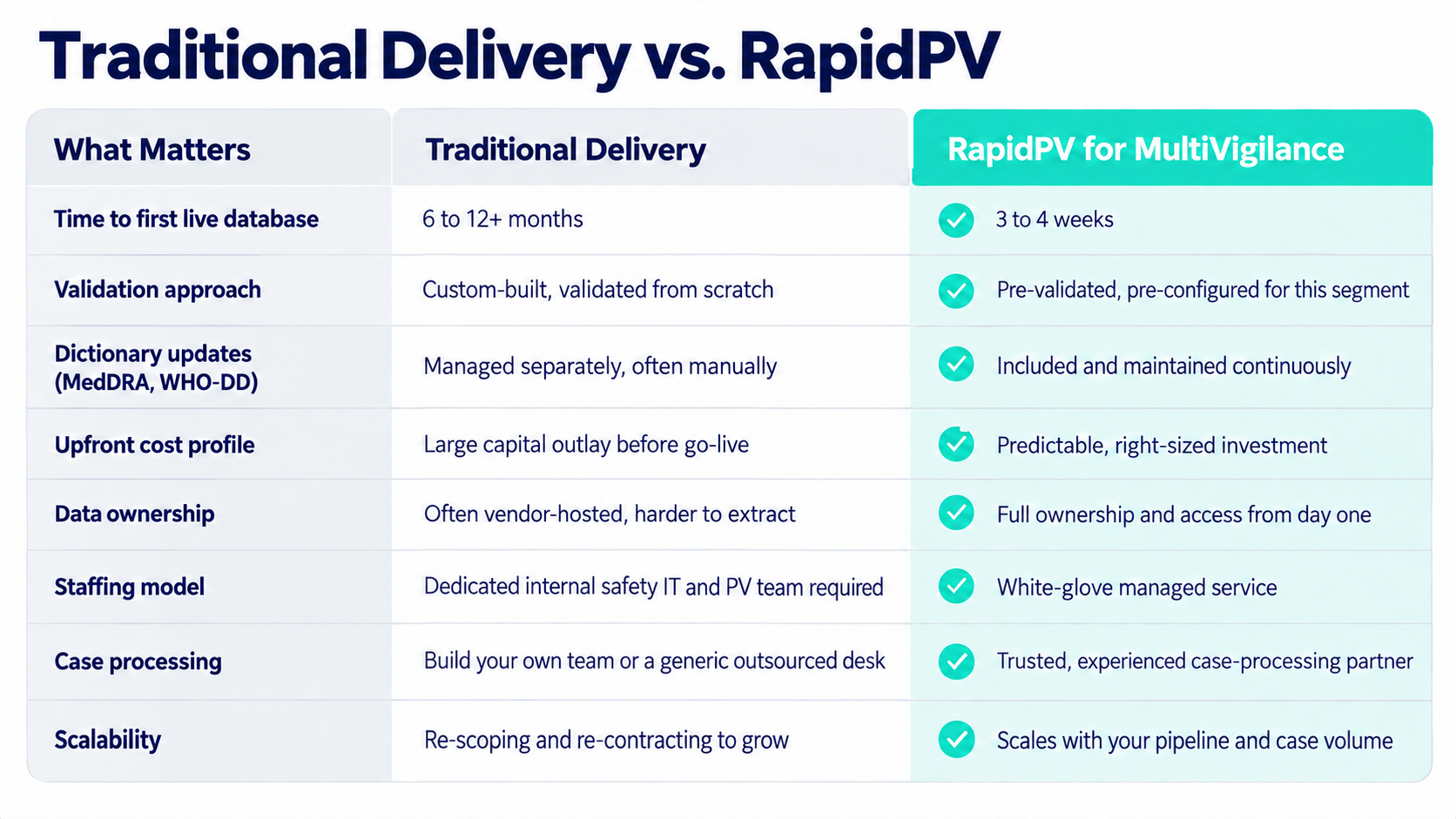
This is exactly where the traditional model for delivering a safety database breaks down for smaller organizations. Legacy implementations were designed around large pharma: long discovery phases, heavily customized configuration, and validation cycles that stretch six months to a year or more before a system is production-ready. For an enterprise sponsor with a multi-year runway and a dedicated safety IT function, that is a manageable cost of doing business. For a ten-person clinical-stage biotech racing toward first-in-human dosing, it can be the difference between hitting a regulatory milestone and missing one entirely.
What RapidPV Actually Changes
RapidPV is ArisGlobal’s answer to that gap. It is a model built to deliver MultiVigilance, the same enterprise-grade safety platform trusted by many of the world’s largest pharmaceutical companies and regulatory agencies, but packaged and delivered in a way that is purpose-built for small, medium, and startup organizations.
The mechanics of how it achieves that speed matter. Instead of starting configuration and validation from a blank page for every customer, RapidPV starts from a foundation that is already pre-configured and pre-validated against the processes and regulatory requirements that this segment of customers consistently needs. What used to take months of configuration and validation effort happens once, well ahead of time, at the platform level. Each new customer inherits a system that is already proven rather than one still being built and tested underneath them.
The result is a live, production-ready MultiVigilance safety database in three to four weeks. Not a pilot. Not a sandbox. A fully validated system ready to receive and process real cases. Already, several of ArisGlobal’s small and mid-size biotech and pharma customers have gone through exactly this path, moving from contract signature to production readiness in roughly a month, instead of the six to twelve months a traditional build would have required.
ArisGlobal provides access to qualified case processing resources through its certified partner network.
Ownership and Control Over Sensitive Data
Speed alone would not be enough if it came at the cost of control. Clinical and safety data is some of the most sensitive information a life sciences company holds, and during R&D, that data is also one of the most important inputs into time-sensitive decision-making. A delayed or opaque view into safety signals is not just an inconvenience; it can directly affect how quickly a company can act on an emerging risk or defend a benefit-risk position to a regulator.
This is where many alternatives fall short. Building an entire internal team for data management, case processing, aggregate reporting, and IT system upkeep is an enormous undertaking for a small organization, both in cost and in specialized expertise that takes years to develop. Fully outsourcing the function to a generic third party solves the resourcing problem, but customers often find themselves with limited visibility into their own data, and gaining meaningful access and control becomes cost-prohibitive, if it is available at all.
RapidPV is deliberately structured to avoid that trade-off. Customers own their safety database and their processes outright. There is no black box and no bound on access. That ownership is what turns a safety database from a compliance obligation into a genuine decision-support asset, one that gives R&D, regulatory, and safety leadership timely, direct insight into their own data exactly when a decision depends on it.
A True White-Glove Partnership
Ownership without support would simply shift the burden back onto a customer that was never trying to become a safety IT organization in the first place. RapidPV pairs full data ownership with a genuinely white-glove managed service. ArisGlobal maintains the system end to end: routine upgrades, MedDRA and WHO-DD dictionary updates, and the ongoing technical care that keeps a validated system validated over time.
On the case-processing side, customers get more than a vendor executing a service-level agreement. They get an experienced partner working as a true extension of their safety team, one that understands the regulatory obligations riding on every ICSR and every expedited report, and that treats the relationship as a shared responsibility for getting it right, not a transaction to be minimized.
Taken together, this is what lets a small or emerging biotech, pharma, device, or CRO organization stay focused on what they do best: R&D, clinical trial execution, regulatory strategy, and commercialization planning, while ArisGlobal handles the infrastructure and operational weight of pharmacovigilance underneath them.
Built to Scale as the Pipeline Matures
Small companies rarely stay small if the science holds up. A single asset in Phase 1 can become a multi-product portfolio moving toward multiple regional launches within a few years. A safety infrastructure that only works at the smallest scale creates its own ceiling. RapidPV is built on the same MultiVigilance platform used by large, established pharmaceutical companies, so the system a customer starts on in week four of their engagement is the same enterprise-grade platform that can support them as case volumes grow, new products enter the portfolio, and global submission requirements expand.
That continuity matters. There is no forced migration to a bigger enterprise system once a company outgrows a starter product, and no re-validation cycle triggered by success. Growth is handled as a configuration and scale conversation, not a re-platforming project.
RapidPV in the Real World: From Kick-Off to Go-Live in Four Weeks
The proof of a model like RapidPV is not in the design. It is in what happens when a real company with real safety requirements puts it into practice.
One growing life sciences organization needed to strengthen its safety infrastructure to support continued growth. At the same time, the organization had limited internal safety resources and little experience implementing a safety database. The team needed a controlled and compliant system but did not have the resources or bandwidth to dedicate to a traditional safety database implementation.
RapidPV offered a different path. Its delivery model addressed the organization’s need to get a safety system into production quickly while minimizing the implementation burden on its internal team. ArisGlobal’s experience supporting pharmacovigilance organizations of different sizes also provided the expertise and support needed as the company established its safety infrastructure.
The results demonstrate what that model can achieve. The implementation was originally anticipated to take six weeks from project kick-off to production go-live. The teams completed it in just four weeks.
With RapidPV now live, the organization has a scalable safety infrastructure designed to support global pharmacovigilance compliance, centralized adverse event and product complaint management, case processing, regulatory reporting, and comprehensive inspection readiness as it continues to grow.
The Takeaway
Every small or mid-size innovator in this industry is making a bet: that their science is strong enough to matter, and that they can move fast enough to prove it before resources run out. Mission-critical systems like a validated safety database should never be the reason that bet takes longer than it needs to. RapidPV exists because ArisGlobal believes that speed, ownership, and genuine partnership do not have to be traded off against each other, and because the companies doing some of the most important early-stage work in this industry deserve infrastructure that moves at their pace, not the pace of a legacy implementation model built for someone else.
Ready to see how fast your MultiVigilance safety database could actually be live?
RapidPV delivers a fully validated, pre-configured LifeSphere MultiVigilance database in three to four weeks, with white-glove management, full data ownership, and a trusted case-processing partner built in from day one. Feel free to reach out to ArisGlobal for more details.